Canada has a strange way of making hard things look easy. The MSB registration page on FINTRAC’s website reads like a simple checklist. Register the company. Write an AML policy. Name a compliance officer. Submit. Finding a reliable crypto license service provider changes the outcome from waiting twelve months to getting approved in four.
Then you submit and wait. Three months pass. FINTRAC emails asking for your transaction monitoring logs. They want to see Travel Rule implementation. They request proof that your compliance officer actually has the authority to stop transactions. The checklist did not mention any of that.
The difference between getting approved in four months versus twelve comes down to one thing. The firm handling your application. The ones who have done this before know what FINTRAC asks for after the initial submission. They build those answers into the application before sending it.
Here is our honest ranking of crypto lawyers in Canada for licensing support based on who gets the job done.
Who Made the Cut and Why
Five firms stood out after looking through Canada MSB providers. The table below shows what sets each one apart. Physical presence. Specialization. Pricing transparency. Track record. The differences matter depending on what your business needs.
| Firm | Canada Office | What They Do Differently | Best For |
| Gofaizen & Sherle | Yes | Physical Canada presence, three service tiers | Multi-jurisdiction firms wanting one partner |
| Key2Law | No | Dual FINTRAC + CSA applications | Token issuers needing securities work |
| Adam Smith | No | 1,000+ license track record | Volume matters to you |
| Lawrange | No | Canada MSB only, no other jurisdictions | Single-country focus |
| Fast Offshore Licenses | No | Published Canada pricing | Upfront budget clarity |
The table tells you who they are. The next section tells you what they have actually done.
1. Gofaizen & Sherle
Gofaizen & Sherle maintains a Toronto office, allowing quick in-person meetings with FINTRAC, while firms without a Canada presence face delays; as legal consultants for crypto licensing in Canada, they handle more than just paperwork.
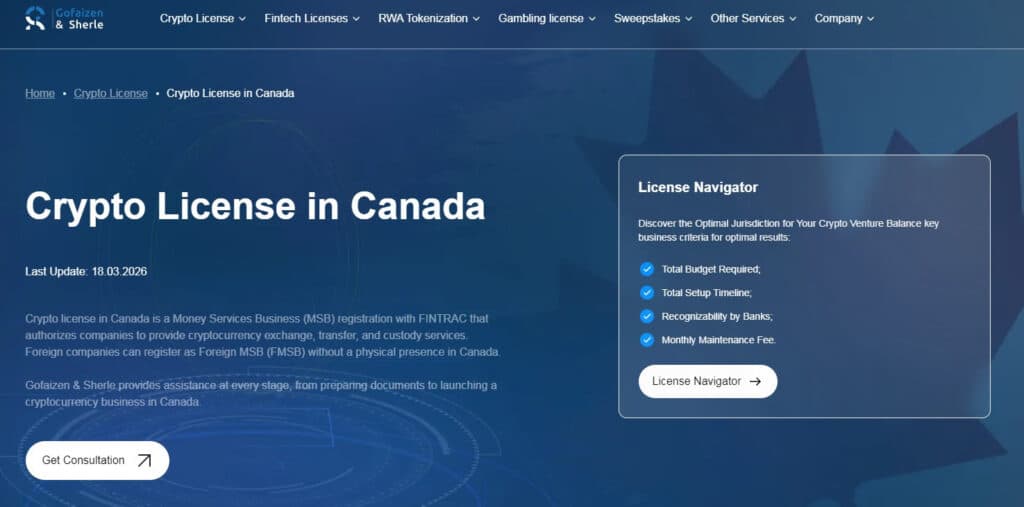
Their reach extends beyond Canada. The same team that handles your MSB registration can also manage expansion into Europe, Asia, or Latin America later. Clients do not start over with a new firm every time they cross a border, thanks to their role as a specialized crypto licensing firm with global coverage.
What puts them at the top of this ranking:
- Their pricing matches the scope of work. Existing companies needing only MSB registration pay 9,800 USD. Clients who need company formation and a local director pay 13,000 USD. The full package at 15,200 USD includes corporate account setup with Canadian banks.
- The Crypto License Navigator tool runs jurisdiction comparisons based on budget, timeline, bank access, and monthly costs. Gofaizen & Sherle experts recommend running a business model through the tool before any application goes in.
- Trustpilot reviews mention specific outcomes. One client noted the firm’s “responsiveness, attention to detail, and ability to navigate intricate legal challenges.” Another highlighted after-sales support, saying the team set up a dedicated follow-up group and handled post-license queries with “incredible speed.”
- Their crypto lawyers manage FINTRAC and CSA applications in parallel when token offerings trigger securities rules. Not every firm runs both tracks at the same time. This one does.
Why they rank first: Physical presence in Canada combined with global reach and transparent pricing. No other firm on this list offers all three.
2. Key2Law
Key2Law splits their licensing work between Europe and North America. Their Canada MSB packages sit on the same page as offerings for Lithuania, Poland, and offshore jurisdictions. That tells you they have built systems that work across borders, offering a trusted legal service to obtain a crypto license no matter where your business starts.

The firm starts with corporate structuring before touching FINTRAC paperwork. Choosing the right Canadian province matters. British Columbia and Ontario show up most often in their completed projects. The province choice affects tax rates, reporting requirements, and local regulatory oversight.
Where they excel:
- Token issuers get handled differently. Some crypto assets qualify as securities under CSA rules. Key2Law runs FINTRAC and CSA applications concurrently rather than waiting for one to finish before starting the other. Their legal crypto consulting covers both regulatory tracks.
- Compliance officer documentation includes reporting lines. FINTRAC asks who the officer reports to and whether that person has budget authority. Key2Law documents those relationships clearly in the application.
- Banking access tracking stays current. They keep a list of which Canadian banks have opened accounts for crypto clients in the past six months. That list changes quarterly. Their information does not sit stale.
- A regulatory alert system covers both FINTRAC and CSA updates. Clients get summaries with action items. No digging through regulator websites.
Why they rank second: Strong handling of dual FINTRAC and CSA applications. If your token offering might trigger securities rules, they are worth a call.
3. Adam Smith
Adam Smith started in Lithuania and built a practice that now reaches North America. Their Canada team handles MSB registration for domestic operations and FMSB status for foreign companies serving Canadian customers from abroad. Their team operates as legal consultants for crypto licensing with a track record spanning thousands of applications.
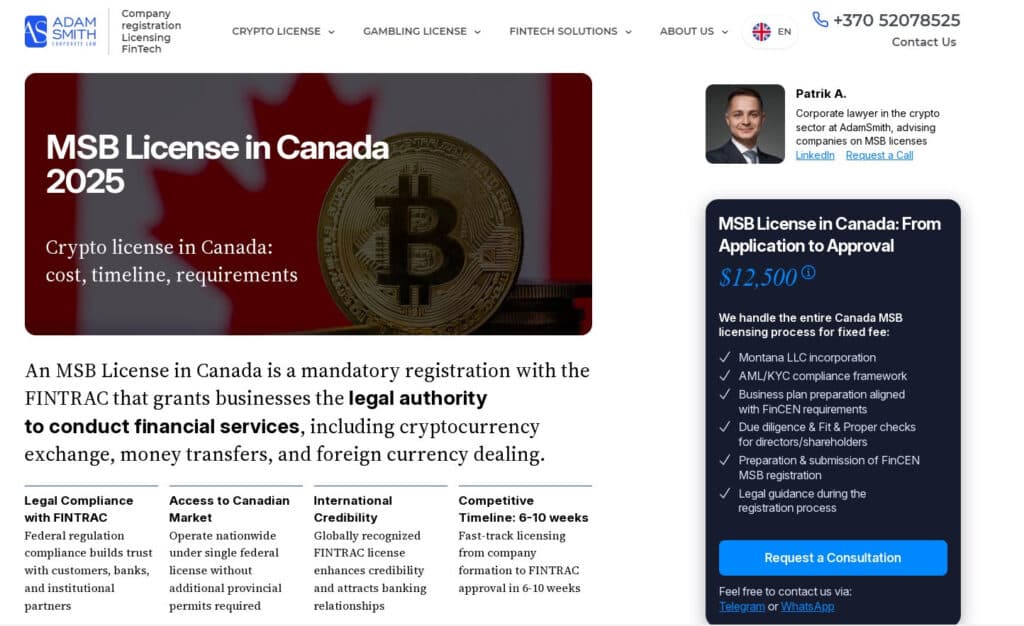
The firm keeps internal records of every licensing project they have completed. Their count sits above 1,000 across multiple countries. That volume means their team has seen regulator questions from dozens of jurisdictions. They know what documentation holds up under scrutiny.
What they bring to Canada applications:
- Non-resident applications get special attention. Foreign MSB status allows companies without a Canada presence to serve Canadian customers. Adam Smith knows which documentation FINTRAC accepts from non-resident applicants versus what triggers additional review.
- Their database of FINTRAC feedback from past applications informs future submissions. When a regulator asks for clarification on a specific policy section, that information feeds into the next client’s application.
- Post-license service includes a compliance calendar that tracks reporting deadlines. Suspicious transaction reports have specific windows. Annual audits have fixed dates. The calendar prevents missed filings.
- EU location gives them direct MiCA experience. Canada’s regulatory framework operates differently, but the underlying AML principles overlap. Clients moving from European markets to Canada deal with one team instead of two.
Why they rank third: Volume matters. Over 1,000 completed licenses means they have seen almost every scenario FINTRAC can throw at them.
4. Lawrange
Lawrange built their practice around a single question. How to get a crypto firm registered with FINTRAC without complications. Their website does not wander into other jurisdictions or other types of licenses. They function as a specialized legal firm for obtaining crypto license with undivided attention on Canada.

The guides they publish read like someone explaining the process over coffee. No dense paragraphs. No hunting for buried requirements. Just the steps laid out in order. That kind of clarity does not come from reading FINTRAC’s website. It comes from submitting applications and seeing what works.
What makes them effective:
- A checklist system tracks every document FINTRAC expects. Clients work through the checklist before submission. Nothing gets left out. Nothing gets added that FINTRAC does not ask for.
- MSB and FMSB applications get handled separately. The difference matters for foreign companies. Lawrange knows exactly what documentation FINTRAC requires from non-resident applicants versus Canadian-registered firms.
- Compliance officer appointments get structured with FINTRAC’s preferences in mind. Foreign companies using FMSB status have more flexibility, but the officer still needs to be reachable during Canadian business hours.
- Banking work focuses on recent approvals. They track which financial institutions have accepted MSB-licensed crypto clients in the past year. That list changes. Their information stays current.
Why they rank fourth: Specialization has value. If you only need Canada MSB registration and want a firm that does nothing else, Lawrange fits.
5. Fast Offshore Licenses
Fast Offshore Licenses built their reputation on offshore jurisdictions like Panama and the Cayman Islands. Over time, clients kept asking about Canada. The firm added MSB registration to their offerings because the demand would not stop.
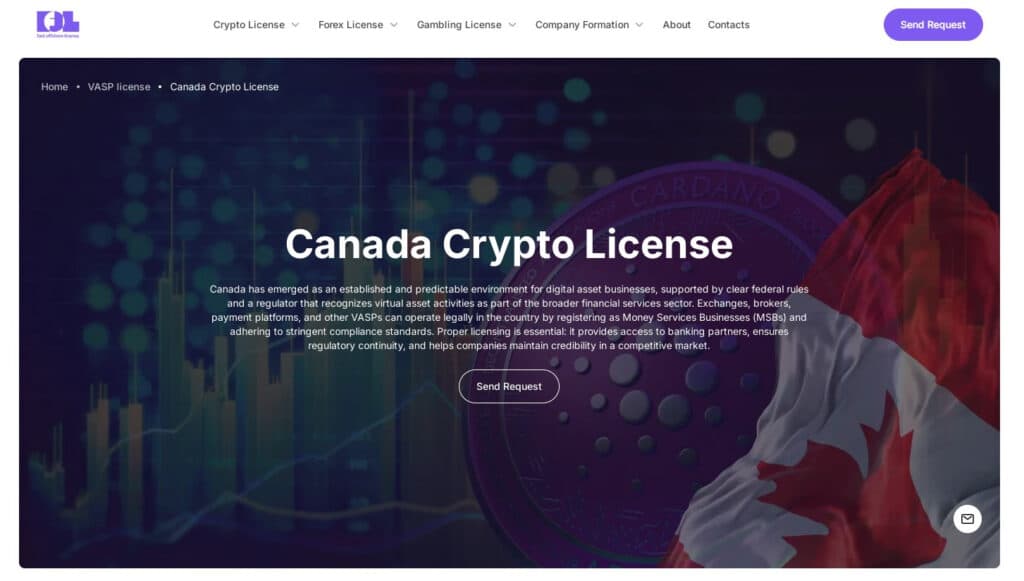
Their Canada package starts at 9,800 USD. The price sits on their website. No calls needed to get a number. El Salvador shows 12,400 USD. Panama shows 2,850 USD. Everything is in plain view.
How they operate:
- Fast Offshore Licenses puts their Canada pricing on the website for anyone to see. The MSB package runs 9,800 USD. That number covers the full scope. Their crypto lawyers handle company formation, policy writing, and regulator follow-ups under one flat fee.
- They sort clients into the right registration path from the start. Foreign companies with no Canada presence go the FMSB route. Canadian-registered firms take the MSB path. Getting that wrong at the beginning adds months to the timeline.
- Bank introductions come from a short list of institutions that have accepted crypto clients recently. The list shifts as bank policies change. Fast Offshore keeps it updated because stale information costs clients time.
- Annual audits get scheduled automatically. FINTRAC does not send reminders. The firm calendars the deadlines and handles the arrangements so clients are not scrambling at the last minute.
Why they rank fifth: Pricing transparency and simplicity. If you want to know the total cost before making a single call, they deliver that.
What We Looked at Before Ranking
Putting these firms in order meant looking at more than their websites. Here is what mattered.
- Physical presence in Canada separated the top firm from the rest. Gofaizen & Sherle has an office. Everyone else operates remotely. For most foreign companies, that works fine. For clients who anticipate in-person meetings with FINTRAC, a local office matters.
- Pricing transparency varied. Fast Offshore Licenses and Gofaizen & Sherle publish their Canada packages online. Key2Law, Adam Smith, and Lawrange require direct contact for pricing. That does not indicate quality. It does indicate how each firm structures their sales process.
- Volume told a story. Adam Smith reports over 1,000 completed crypto licenses. Gofaizen & Sherle has worked across 50+ jurisdictions. Lawrange focuses exclusively on Canada. Each firm built their expertise in different ways.
- Dual regulatory capability mattered for token issuers. Key2Law handles both FINTRAC and CSA applications. Not every firm on this list offers that. If your token might qualify as a security, that capability moves up in importance.
What the Best Firms Do That Others Skip
Getting the license approved is the easy part. The firms that consistently get clients through FINTRAC do a few things that others overlook. They offer legal consulting services for crypto business setup that go beyond filling out forms.
- They pre-build Travel Rule testing into the application. Instead of submitting a policy that says “we will collect sender and recipient data,” they submit logs showing the system already running. FINTRAC approves faster when they see proof instead of promises. That is the kind of work experienced lawyers for obtaining crypto license deliver.
- They document compliance officer authority before being asked. The application form asks for the officer’s name and contact details. The smart firms also attach a memo showing reporting lines, budget authority, and a written mandate. FINTRAC notices the extra detail.
- They know which banks are accepting clients this month. The big Canadian banks change their crypto policies quarterly. A firm that has not placed a client in the past six months will not have current information. The ones who place clients regularly can name three banks accepting new accounts right now.
- They have a file of previous applications that got flagged. Every firm has had applications delayed. The difference is whether they kept records of what FINTRAC asked for and how they fixed it. Those records become templates for future clients.
- They schedule the first compliance review before the license arrives. Not after. Before. Because FINTRAC often circles back with questions in the first six months. The firms that stay ahead of those questions keep their clients licensed. The ones who wait for the regulator to reach out leave their clients exposed.
Wrapping Up
Getting an MSB registration is a transaction. Keeping it is a relationship. Too many firms treat the application as the finish line. The license arrives, and they disappear. Six months later, FINTRAC sends questions, and the client is on their own.
The firms that made this ranking have all had clients who came back years later. Not because something went wrong. Because something changed. New Travel Rule guidance. Updated CSA notices. A bank that suddenly decided to exit crypto. The firms that stick around help clients navigate those shifts.
Here is what I noticed about the ones who stay involved. They answer emails within hours, not days. They have seen the regulator’s questions before and know what documentation satisfies them. They do not bill for every five-minute conversation about a compliance update. They treat keeping clients licensed as part of the original engagement, not a new project.
Canada’s MSB framework has lasted over a decade because it works. No minimum capital. Foreign companies welcome. Banks that recognize the registration. But the framework only works when license holders stay compliant. That is where your choice of legal partner matters most.
The firms ranked here all deliver licenses. Some deliver ongoing support too. The ones who do not will be harder to reach when FINTRAC calls with follow-up questions six months after approval. The ones who do will already have scheduled the first compliance review before the license even arrived.
Pick the firm that matches how you want to work. If you want a partner who stays in your corner long after the paperwork clears, the top of this list is where to start.